Quick navigation
- Stories
- Events
-
Magazine
- History
- Person
- My experience
- Inspiration
- Controversies & Ethics
- Cultural perspectives
- Legal & Business
- Behind the scenes
-
Guide
- Travel Guide
- Questions & Answers
- Shop
- Forums
- Forums
-
Blogs
- All Blogs
- Create Blog
- Users
- Login


Table of content
1. The eye of an artist, the mind of a scientist, and the heart of a journalist2. Ed Koch, 1989
3. The controversial Bush portrait, 1990
4. Rudolph Giuliani, 2001
5. Luis Sarria, 1987
6. Mick Jagger and Tina Turner, 1985
7. Michael Phelps, 2005
8. Jodie Foster, 1991
9. Senator John Glenn, 1998
10. George W. Bush, 1995
11. Bruce Springsteen, 2002
12. Denzel Washington
13. Mike Ditka and Ricky Williams, 2005
14. David Lynch, 1990
15. Hillary Clinton, 1992
16. The role of education and legacy
- November 20, 2025 at 9:58 PM
-
5.2K
-
1 comment
Luis Sarria: intimacy, silence, and the gift of a gesture
The portrait of Luis Sarria, Muhammad Ali’s masseur, shot in Miami, Florida, is one of the most significant and widely acclaimed works in Gregory Heisler’s career. Heisler himself has called it one of the two frames in his professional life that he was most satisfied with.
Shot in black and white, the portrait captures Sarria’s “strong yet gentle” gesture. At that time he was already very old and, by all appearances, a rather frail man. Luis Sarria was Muhammad Ali’s personal masseur, physical trainer, and cornerman throughout the boxer’s entire professional career. The image later became central to Heisler’s body of work, appearing on the cover of his monograph 50 Portraits.
The photograph was commissioned by Sports Illustrated for an editorial feature titled Ali and His Entourage, written by Gary Smith. Heisler’s task was to photograph seven people who formed Muhammad Ali’s inner circle during his prime.
Photo editor Kathy Mather set an unexpected requirement: this had to be the first black-and-white essay of Heisler’s career. Heisler was surprised by the choice because he was usually seen as a color specialist or a technical expert.
Heisler gladly accepted the assignment. He loved working in black and white, seeing it as “more content-driven” and placing the subject “one step removed from reality.” This allowed him to focus on “mood and feeling.” Gary Smith’s piece was “highly visual,” telling a story about emotions and relationships.
The conceptual challenge lay in conveying the unique bond between Sarria and Ali. Muhammad Ali was the greatest “talker” of his era, but with Sarria—who was Cuban and spoke English poorly—he communicated almost like a mime, enjoying long stretches of silence that the writer described as “a blessed state.” Heisler set out to reveal “the sweetness of his soul and the strength of his hands.”
The shoot took place in Miami, Florida. When Heisler and his assistant Monica Buck arrived, they waited by a chain-link fence in the heat. Sarria’s house was described as an old wooden frame structure on a dry, dusty, barren lot. Initially, Heisler planned an environmental portrait to minimize attention to Sarria’s swollen face, but he abandoned the idea because the story was about the man, not the place. The portrait was eventually made right where Sarria sat on the porch beside the photographer.
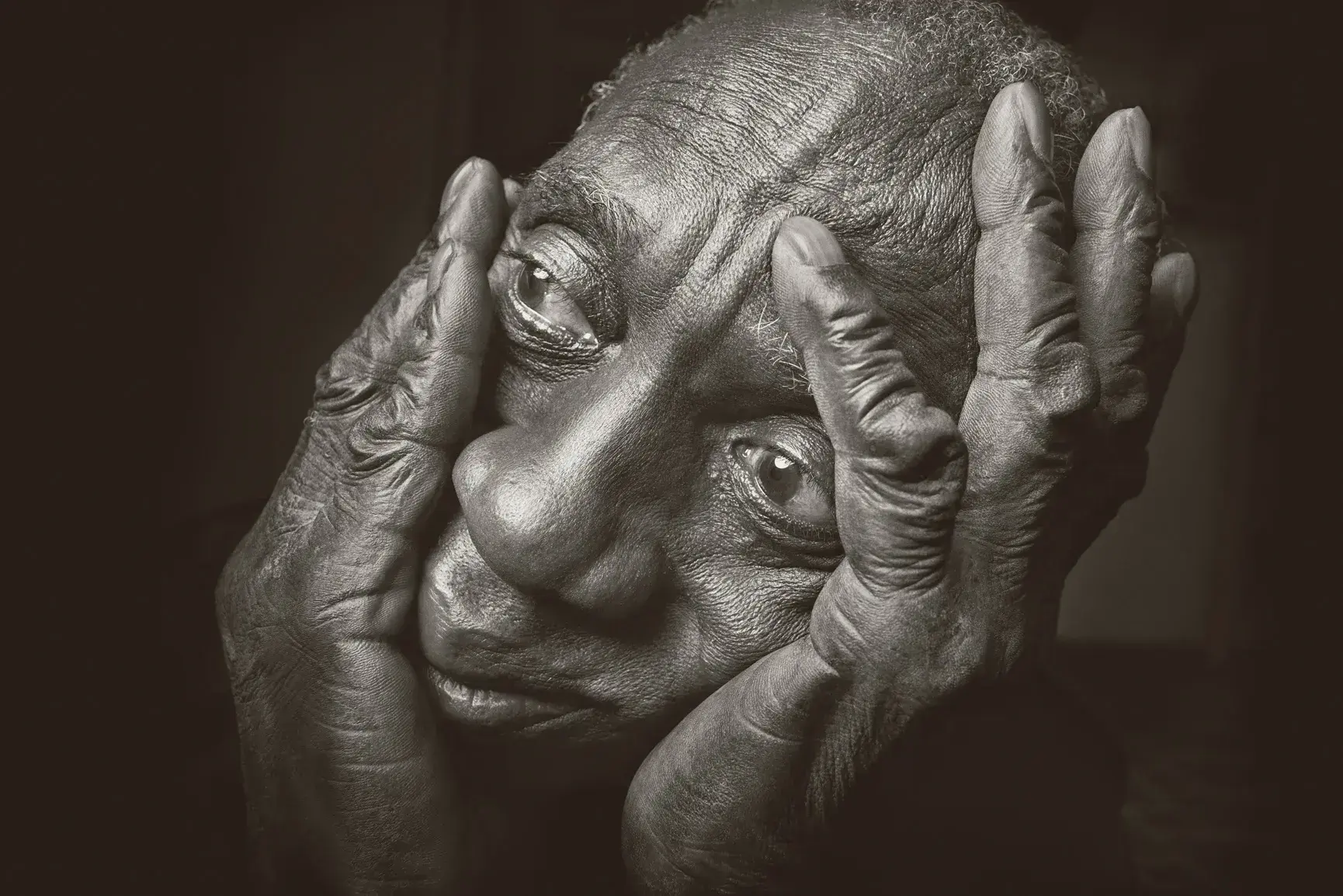
Heisler used a bulky camera, described in sources as a medium-format 6×7 system.
He chose a 50 mm lens. This focal length (equivalent to roughly 28–35 mm on full-frame) gave the portrait a “three-dimensional feel” and slightly enlarged the hands. The shoot happened extremely fast, and Heisler exposed only about 12–15 frames.
Following his “Heart of a Journalist” principle, Heisler aimed to “elicit a gesture rather than a pose.” He tried to avoid the “six standard male poses” he sees so often in portraiture and worked toward natural behavior.
Heisler used only one light source. It was nothing special—just a small, worn, tape-wrapped battery-powered flash, because there was no access to electricity.
He applied a “close light” technique, which he favors because it makes the light softer rather than harsher. When a light comes close to the subject, it strikes from multiple angles, causing it to wrap. Assistant Monica held the light by hand, allowing “the tiniest refinements.”
Heisler also used “feathering”: instead of aiming the center of the beam directly at the subject, he pointed it past Sarria so he would catch only the softer, half-shadow edge of the source. This softens the light, helps it wrap, and separates the subject by darkening the background.
For Heisler, this was the first time he used his lighting not to “solve a technical problem,” but to “convey a feeling.” He believed Sarria deserved “the tenderness suggested by that particular light.” A single directional source created a strong chiaroscuro effect, emphasizing Sarria’s bone structure, deep eye sockets, and complex skin texture—adding biographical weight and history to the portrait.
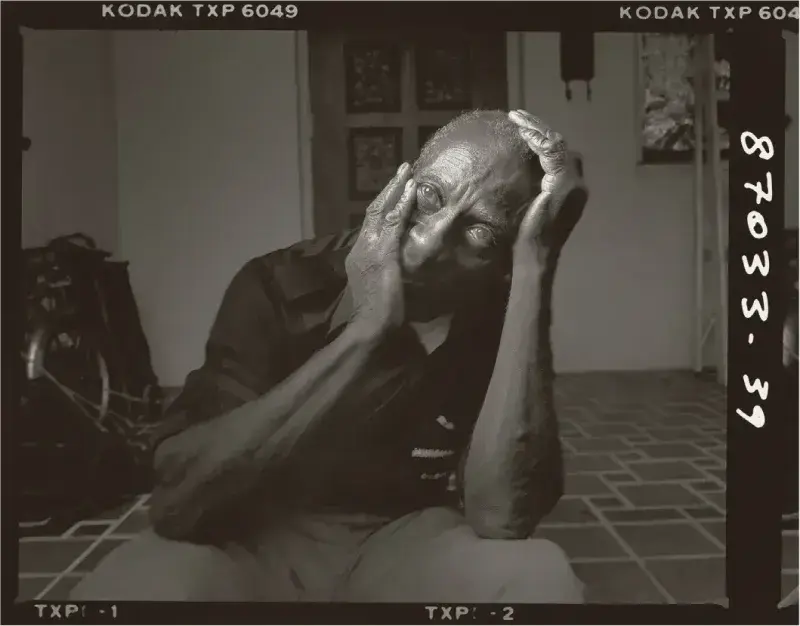
At first, Luis Sarria did not want to be photographed because he was unwell. He had a severe infection that caused the right side of his upper lip to swell painfully, and he was embarrassed to come out.
Monica, who spoke Spanish (Sarria spoke little English and was Cuban), persuaded his wife, describing Heisler as the kindest and most understanding artist. When Sarria came out and sat on an old metal chair, he was tense. Heisler, wanting the man to “offer a gesture, not a pose,” tried shooting him in his environment to give him space. But Sarria kept bringing his hand up to cover his mouth.
Heisler realized that this discomfort-driven gesture was “a gift.” He came closer and began shooting, making a few quick Polaroids so Sarria could see what the camera saw. The frame showed no porch and no swollen lip. Seeing this, Sarria relaxed, shifted slightly, and instinctively cradled his head in his “large, expressive hands.”
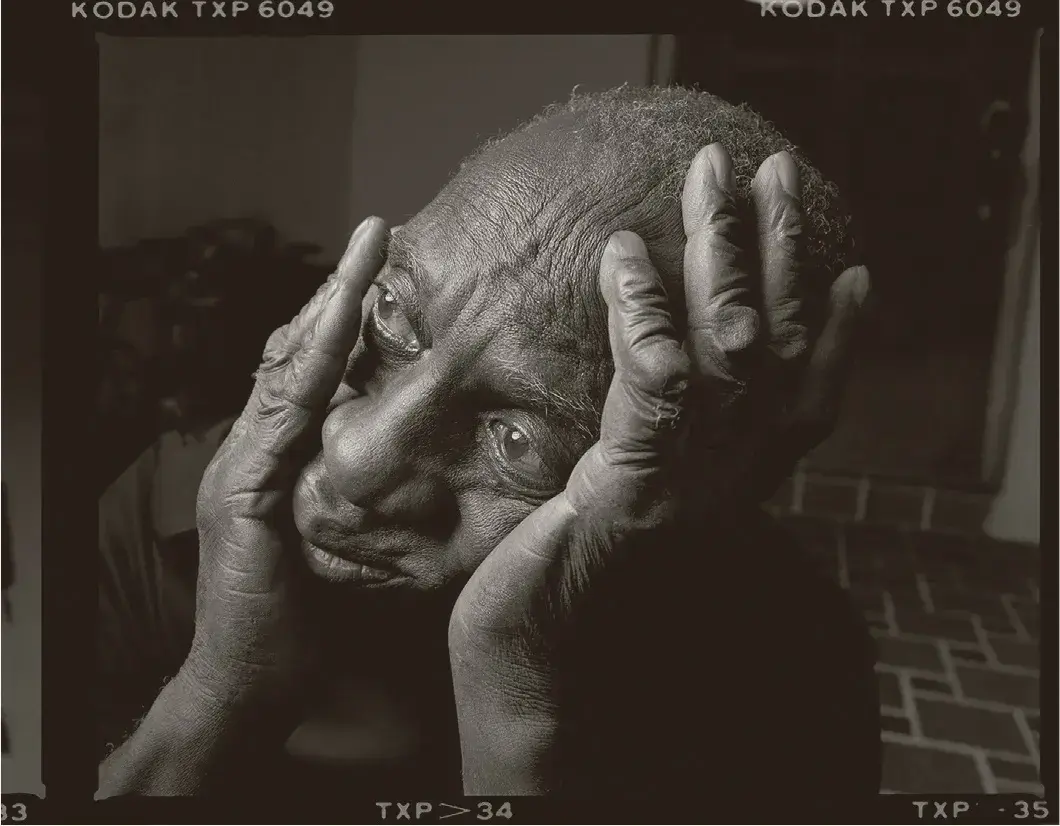
The portrait of Sarria holding his face became the embodiment of a sincere, unforced moment—one not imposed by the photographer. It fused technical mastery with human resonance.
Heisler deliberately chose this portrait—not his photographs of world leaders or celebrities—for the cover of 50 Portraits. It was a philosophical statement: Sarria’s portrait was chosen because it was “transparent to the core of humanity,” free from the famous façade public figures project.
The photograph received wide recognition. It was exhibited in galleries including the National Portrait Gallery of the Smithsonian Institution. In 1998, a gelatin silver print of the image sold at Christie’s for 1,544 USD, a record price for Heisler at the time.
Sarria, described as “a quiet man” and “a priest devoted to the religion of boxing,” is portrayed as an archetype of dedication and labor. His powerful hands became a symbol of decades of physical mastery.

Zheludkov Andrii
CEO at Photo.Travel. In case of urgent questions or cooperation, please, drop me a line on andrzej@photo.travel. I speak English, Ukrainian, Russian.
Comments